When Interpreting Vif in R, Which Column to Read
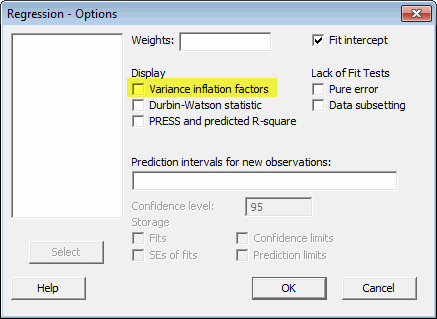
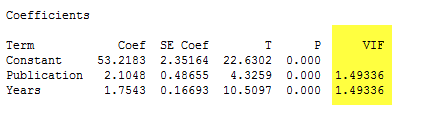
In regression analysis, we look at the correlations between i or more input variables, or factors, and a response. We might look at how baking time and temperature relate to the hardness of a piece of plastic, or how educational levels and the region of one's birth relate to annual income. The number of potential factors you lot might include in a regression model is limited only past your imagination...and your capacity to actually gather the data yous imagine. But before throwing data most every potential predictor under the sunday into your regression model, remember a thing called multicollinearity. With regression, equally with so many things in life, at that place comes a point where calculation more is not better. In fact, sometimes not but does adding "more" factors to a regression model neglect to brand things clearer, it actually makes things harder to sympathise! In regression, "multicollinearity" refers to predictors that are correlated with other predictors. Multicollinearity occurs when your model includes multiple factors that are correlated not just to your response variable, only as well to each other. In other words, it results when you take factors that are a flake redundant. You can think nigh information technology in terms of a football game game: If i thespian tackles the opposing quarterback, it'due south easy to give credit for the sack where credit's due. But if three players are tackling the quarterback simultaneously, information technology'due south much more difficult to make up one's mind which of the 3 makes the biggest contribution to the sack. Non that into football? All right, try this illustration instead: You get to run into a rock and scroll ring with two cracking guitar players. You're eager to see which one plays best. Only on stage, they're both playing furious leads at the same fourth dimension! When they're both playing loud and fast, how can you tell which guitarist has the biggest effect on the audio? Even though they aren't playing the same notes, what they're doing is then similar information technology's difficult to tell one from the other. That's the problem with multicollinearity. Multicollinearity increases the standard errors of the coefficients. Increased standard errors in turn ways that coefficients for some contained variables may be found non to be significantly unlike from 0. In other words, by overinflating the standard errors, multicollinearity makes some variables statistically insignificant when they should exist significant. Without multicollinearity (and thus, with lower standard errors), those coefficients might exist significant. A little fleck of multicollinearity isn't necessarily a huge problem: extending the stone band analogy, if one guitar player is louder than the other, you can easily tell them apart. But severe multicollinearity is a major trouble, because it increases the variance of the regression coefficients, making them unstable. The more variance they accept, the more difficult it is to interpret the coefficients. So, how do you know if you demand to be concerned about multicollinearity in your regression model? Hither are some things to watch for: One way to mensurate multicollinearity is the variance inflation cistron (VIF), which assesses how much the variance of an estimated regression coefficient increases if your predictors are correlated. If no factors are correlated, the VIFs will all be one. To have Minitab Statistical Software calculate and display the VIF for your regression coefficients, just select it in the "Options" dialog when you lot perform your analysis. With Display VIF selected as an option, Minitab will provide a table of coefficients as part of its output. Here'south an example involving some data looking at the relationship between researcher salary, publications, and years of employment: If the VIF is equal to 1 there is no multicollinearity among factors, simply if the VIF is greater than 1, the predictors may be moderately correlated. The output in a higher place shows that the VIF for the Publication and Years factors are nigh 1.5, which indicates some correlation, just not enough to be overly concerned about. A VIF between v and 10 indicates high correlation that may be problematic. And if the VIF goes above 10, you can assume that the regression coefficients are poorly estimated due to multicollinearity. You lot'll desire to practise something virtually that. If multicollinearity is a problem in your model -- if the VIF for a factor is nigh or in a higher place 5 -- the solution may be relatively simple. Try one of these: With Minitab Statistical Software, it's like shooting fish in a barrel to utilize the tools available in Stat > Regression menu to quickly test dissimilar regression models to find the best i. If y'all're not using it, we invite you lot to try Minitab for gratis for thirty days. Have you lot ever run into issues with multicollinearity? How did you solve the trouble? What Is Multicollinearity and Why Should I Care?
Warning Signs of Multicollinearity
How Can I Deal With Multicollinearity?
Source: https://blog.minitab.com/en/understanding-statistics/handling-multicollinearity-in-regression-analysis
0 Response to "When Interpreting Vif in R, Which Column to Read"
Post a Comment